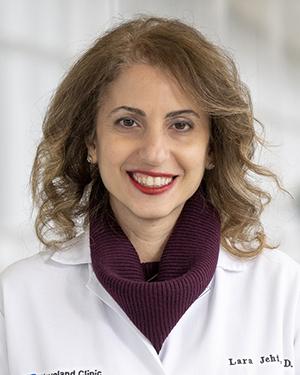
Lara Jehi, MD, MHCDS
Department Chair
Computational Life Sciences
Chief Research Information Officer, Cleveland Clinic Enterprise
Executive Program Lead, Discovery Accelerator
Email: [email protected]
Location: Cleveland Clinic Main Campus
Research
My research integrates advanced computational methods with clinical epilepsy to improve patient outcomes. I develop and apply predictive models, machine learning, quantum computing, and large-scale data analytics to better understand disease mechanisms and personalize treatment, particularly in epilepsy surgery. By bridging data science and clinical care, my work aims to transform epilepsy management into a more precise, evidence-driven discipline.
Biography
Dr. Jehi is Cleveland Clinic’s inaugural Chief Research Information Officer and holder of the Sondra J. and Stephen R. Hardis Endowed Chair for Research and Technology. She is professor of neurology at Cleveland Clinic Lerner College of Medicine, and an epilepsy specialist.
Dr. Jehi is Executive Program lead for the Discovery Accelerator, which now spans more than 60 projects focused on artificial intelligence, quantum computing, data science education and numerous international initiatives, including with the U.K.’s Science and Technology Facilities Council’s Hartree Centre and the Novo Nordisk Foundation in Denmark. She led the creation of the Ohio Quantum Institute with Miami University, building the quantum talent pipeline through bachelor’s, master’s, and PhD degrees in quantum computing, and co-leads the Advanced Computational Life Sciences Center of Excellence between Cleveland Clinic and Carnegie Mellon University focused on collaborative research in drug and biomarker discovery, Neuroquantum technologies, and quantum-centric-supercomputing. She also serves advisory roles in data and technology for industry and federal agencies including the National Institutes of Health, Food and Drug Administration and the National Academy of Medicine. She served as a vice-chair of Cleveland Clinic’s Institutional Review Board and currently chairs several key committees in the International League Against Epilepsy and the American Epilepsy Society. In January 2026, she was appointed to the Advisory Committee to the newly created Office of Science at the US Department of Energy.
Dr. Jehi, a long-time innovator, led the development of the first nomograms for individualized outcome prediction after epilepsy surgery. Her work was featured by Lancet Neurology in the Top 5 Innovations of 2015, and in the “Notables in Healthcare” Award by Crain’s Business in 2021. Her data-driven algorithms for clinical care decision-making are being used, studied and expanded worldwide. She is a sought-after speaker with >100 keynotes on technology and medicine globally, including the House of Lords in UK, and Karolinska Institute in Sweden.
Dr. Jehi’s research contributions include more than 230 peer-reviewed publications and 12 book chapters. She spearhead multiple multi-institutional National Institutes of Health- funded grants focused on data science, biomarker discovery, prediction models, and real-world-data research.
Education & Professional Highlights
Master’s - Dartmouth College, Healthcare Delivery Science Hanover, NH USA 2020
Fellowship– Cleveland Clinic Epilepsy Cleveland, OH USA 2006
Residency – Cleveland Clinic Neurology Cleveland, OH USA 2004
Medical Education – American University of Beirut Medicine Beirut, Lebanon 1999
Undergraduate - American University of Beirut Biology Beirut, Lebanon 1995
Research
Overview
Our research group is interested in developing the concept of precision surgery for epilepsy. We apply advanced computational approaches through machine learning/quantum computing for the dual purpose of predicting surgical and medical outcomes, and elucidating the mechanisms driving those outcomes.
We focus in our lab on understanding how clinical, environmental, and genetic factors shape outcomes. We defined the natural history and mechanisms of seizure recurrence after epilepsy surgery, showing that early recurrence is primarily driven by incomplete resection of the epileptogenic zone, whereas late recurrence reflects ongoing epileptogenesis. These findings catalyzed research into improved seizure localization and the molecular basis of post-surgical epileptogenesis. In parallel, we pioneered individualized prediction of seizure and cognitive outcomes, developing nomograms and online risk calculators that are used worldwide.
We are now pursuing several lines of study:
- Investigate genetically driven neuroinflammation and brain healing as a key determinant of long-term outcomes and a potential target for perioperative intervention.
- Identify circulating biomarkers of epilepsy surgery outcomes
- Characterize brain networks that influence cognitive and epilepsy outcomes using scalp EEG.
- Investigate the links between volumetric brain measurements and epilepsy manifestations.
- Real-world-data research leveraging the electronic health record for landscaping of disease and comparative effectiveness.
- Explore the role of quantum computing in computational epilepsy research.
Seminal Contributions:
Dr. Jehi’s work shaped global epilepsy care. Her research on surgical timing informed International League Against Epilepsy guidelines for epilepsy surgery referral. Her contributions to computational science and individualized risk prediction were recognized by Lancet Neurology among the Top 5 Innovations of 2015 and by Crain’s Cleveland Business in 2021. Her research established stereo-EEG as the preferred intracranial evaluation approach, accelerating its adoption.
She is founding Chair of Computational Life Sciences and Executive Leader of the Discovery Accelerator, home to the world’s first quantum computer dedicated to life sciences research.
- Improved outcomes with earlier surgery for intractable frontal lobe epilepsy[LJ1]
- Development and validation of nomograms to provide individualised predictions of seizure outcomes after epilepsy surgery: a retrospective analysis
- Comparative Effectiveness of Stereotactic Electroencephalography Versus Subdural Grids in Epilepsy Surgery.[LJ3]
- Can quantum computing crack the biggest challenges in health?
In the News
Our Team
Selected Publications
View publications for Lara Jehi, MD, MHCDS
(Disclaimer: This search is powered by PubMed, a service of the U.S. National Library of Medicine. PubMed is a third-party website with no affiliation with Cleveland Clinic.)
Pucci Francesco, Worrell Samuel, Jehi Lara. Fully automated three-dimensional deep learning-based magnetic resonance imaging segmentation of brain cavities in epilepsy surgery. Epilepsia. 2026. 42284022.
Jehi Lara. Building systems-based epilepsy surgery in sub-Saharan Africa - Authors' reply. Lancet Neurol. 2026. 42127927.
Jehi Lara. IFCN position statement: use of artificial intelligence in clinical neurophysiology. Clin Neurophysiol. 2026. 42067415.
Choi Junggu, Yu Chansu, Jung Kyle L, Comhair Suzy Aa, Jehi Lara, Jung Jae U. Performance evaluation of quantum support vector machine for COVID-19 biomarker analysis. Comput Methods Programs Biomed. 2026. 41966795.
Martyn Trejeeve, Hanna Mazen, Nissen Steven E, Patolia Harsh, Rajendran Judah, Tang W H Wilson, Vest Amanda R, Cho Leslie, Svensson Lars G, Gerds Aaron, Kapadia Samir, Jehi Lara, Sarraju Ashish. Automating Chart Review Using an Artificial Intelligence-Enabled System for Assessing Transthyretin Amyloid Cardiomyopathy Trial Eligibility. J Card Fail. 2026. 41785956.
Jehi Lara. AES ILAE North America Symposium: Guiding Evidence-Based Epilepsy Management. Epilepsy Curr. 2026. 41768593.
Khoury Jean, Vegh Deborah, Jehi Lara E. Timing for Starting Antiseizure Medication Withdrawal After Epilepsy Surgery in Adults. Neurology. 2026. 41592265.
Jehi Lara. A call for ethical, equitable, and effective artificial intelligence to improve care for all people with epilepsy: A roadmap. A report by the ILAE Global Advocacy Council and Big Data Commission. Epilepsia. 2026. 41443971.
Jehi Lara. Emerging technologies and strategies in epilepsy surgery: toward personalised medicine. Lancet Neurol. 2026. 41389832.
Jehi Lara. Clinician Feedback Regarding Novel Graphical Risk Prediction Tools for Antiseizure Medication Discontinuation: A Qualitative Study. Neurol Clin Pract. 2025. 41089207.
Busch Robyn M, Jehi Lara. Seminars in epileptology: Presurgical epilepsy evaluation. Epileptic Disord. 2025. 40991343.
Gupta Ajay, Huang Honglian, Thompson Nicolas R, Jehi Lara, Serletis Demitre, Bingaman William E. Epilepsy Surgery in Tuberous Sclerosis Complex: A TSC Natural History Database Study. Pediatr Neurol. 2025. 40752032.
Das Nikita, Sharma Akshay, Shen Jingdi, Munyeshyaka Maxime, Vegh Deborah, Bingaman William, Jehi Lara. Metabolic syndrome as a modifiable risk factor for complications after epilepsy surgery. J Neurosurg. 2025. 40712170.
Jehi Lara. ILAE position on early surgery for drug sensitive lesional focal epilepsy. Brain. 2025. 40681963.
Jehi Lara. Population-based spectral characteristics of normal interictal scalp EEG inform diagnosis and treatment planning in focal epilepsy. Sci Rep. 2025. 40646034.
Jehi Lara. Applications of quantum computing in clinical care. Front Med (Lausanne). 2025. 40337272.
Shen Jingdi, Rotroff Daniel, Vegh Deborah, Punia Vineet, Jehi Lara. Peri-operative anti-inflammatory drug use and seizure recurrence after resective epilepsy surgery: Target trials emulation. iScience. 2025. 40241751.
Jehi Lara. Unlocking the Potential of Telemedicine in Epilepsy: Noninferiority Analysis of Efficacy and Identifying Patient Preferences. Neurol Clin Pract. 2025. 40144688.
Busch Robyn M, Serletis Demitre, Jehi Lara. Comparative Review of Seizure and Cognitive Outcomes in Resective, Ablative, and Neuromodulatory Temporal Lobe Epilepsy Surgery. Epilepsy Curr. 2025. 40028188.
Jehi Lara. The Value of Normal Interictal EEGs in Epilepsy Diagnosis and Treatment Planning: A Retrospective Cohort Study using Population-level Spectral Power and Connectivity Patterns. medRxiv. 2025. 39973994.
Jehi Lara. Epilepsy Therapies Symposium | Do We Really "Outgrow" Seizures? Epilepsy Curr. 2024. 39712399.
Arrotta Kayela, Lapin Brittany, Hogan Thomas, Jehi Lara, Busch Robyn M. External validation of the Memory Assessment Clinics Scale for Epilepsy (MAC-E). Epilepsy Behav. 2025. 39642672.
Jehi Lara. Advances in Therapy for Refractory Epilepsy. Annu Rev Med. 2025. 39532109.
Jehi Lara, Wang Irene. Big data research is everyone's research-Making epilepsy data science accessible to the global community: Report of the ILAE big data commission. Epileptic Disord. 2024. 39446076.
Sheikh Shehryar R, McKee Zachary A, Ghosn Samer, Jeong Ki-Soo, Kattan Michael, Burgess Richard C, Jehi Lara, Saab Carl Y. Machine learning algorithm for predicting seizure control after temporal lobe resection using peri-ictal electroencephalography. Sci Rep. 2024. 39294238.
Tsai Carolyn, Taylor Sara, Thompson Nicolas, Vegh Deborah, Bingaman William, Jehi Lara, Punia Vineet. Role of comorbidities in epilepsy surgery outcomes of older adults. Epilepsia. 2024. 39283622.
Jehi Lara E. Exit Strategy: Balancing the Risks and Rewards of Antiseizure Medication Withdrawal. Epilepsy Curr. 2024. 38898899.
Sharma Akshay, Parfyonov Maksim, Tiefenbach Jakov, Hogue Olivia, Nero Neil, Jehi Lara, Serletis Demitre, Bingaman William, Gupta Ajay, Rammo Richard. Predictors of therapeutic response following thalamic neuromodulation for drug-resistant pediatric epilepsy: A systematic review and individual patient data meta-analysis. Epilepsia. 2024. 38265348.
. Predictive models of epilepsy outcomes. Curr Opin Neurol. 2024. 38224138.
Jehi Lara. Prediction tools and risk stratification in epilepsy surgery. Epilepsia. 2024. 38060351.
Pucci Francesco, Worrell Samuel, Jehi Lara. Fully automatic segmentation of brain lacunas resulting from resective surgery using a 3D deep learning model. medRxiv. 2024. 38014004.
Hershberger Courtney E, Louis Shreya, Busch Robyn M, Vegh Deborah, Najm Imad, Bazeley Peter, Eng Charis, Jehi Lara, Rotroff Daniel M. Molecular subtypes of epilepsy associated with post-surgical seizure recurrence. Brain Commun. 2023. 37881482.
Jehi Lara. Telemedicine as a path to bridging inequities in patients with epilepsy. Epilepsia. 2023. 37811672.
Hsieh Jason K, Sundar Swetha J, Lu Elaine, Desai Ansh, Gupta Ajay, Moosa Ahsan N, Bingaman William, Jehi Lara, Bulacio Juan. Determinants of epileptogenic zone identification and seizure outcome in children with refractory epilepsy undergoing stereoelectroencephalography. J Neurosurg Pediatr. 2023. 37728414.
Desai Ansh, Sharma Akshay, Sundar Swetha J, Hsieh Jason K, Kondylis Efstathios, Patel Arpan, Bulacio Juan, Gupta Ajay, Jehi Lara, Bingaman William. The impact of skull thickness on pediatric stereoencephalography electrode implantation and technical considerations. J Neurosurg Pediatr. 2023. 37728404.
Montanucci Ludovica, Leu Costin, Lal Dennis. Genome-wide identification and phenotypic characterization of seizure-associated copy number variations in 741,075 individuals. Nat Commun. 2023. 37474567.
Jehi Lara. Machine Learning for Precision Epilepsy Surgery. Epilepsy Curr. 2023. 37122399.
Busch Robyn M, Dalton Jarrod E, Jehi Lara, Ferguson Lisa, Krieger Nikolas I, Struck Aaron F, Hermann Bruce P. Association of Neighborhood Deprivation With Cognitive and Mood Outcomes in Adults With Pharmacoresistant Temporal Lobe Epilepsy. Neurology. 2023. 37076308.
Busch Robyn M, Ferguson Lisa, Jehi Lara, Khoury Jean, Lal Dennis, Najm Imad M. Exome sequencing of 20,979 individuals with epilepsy reveals shared and distinct ultra-rare genetic risk across disorder subtypes. medRxiv. 2024. 36865150.
Alzahrany Majed, Jehi Lara. Epilepsy Surgery Outcome of Traumatic Intradiploic Meningoencephalocele: A Case Report and Literature Review. Clin EEG Neurosci. 2024. 36520585.
Khoury Jean, Yardi Ruta, Vegh Deborah T, Jehi Lara. Predictive models for starting antiseizure medication withdrawal following epilepsy surgery in adults. Brain. 2023. 36415957.
Hsieh Jason K, Pucci Francesco G, Sundar Swetha J, Kondylis Efstathios, Sharma Akshay, Sheikh Shehryar R, Vegh Deborah, Moosa Ahsan N, Gupta Ajay, Najm Imad, Rammo Richard, Bingaman William, Jehi Lara. Beyond seizure freedom: Dissecting long-term seizure control after surgical resection for drug-resistant epilepsy. Epilepsia. 2023. 36281562.
Zhou Yadi, Hou Yuan, Jehi Lara, Erzurum Serpil C, Cheng Feixiong. A comprehensive SARS-CoV-2-human protein-protein interactome reveals COVID-19 pathobiology and potential host therapeutic targets. Nat Biotechnol. 2023. 36217030.
Esper Frank P, Adhikari Thamali M, Tu Zheng Jin, Cheng Yu-Wei, El-Haddad Kim, Farkas Daniel H, Bosler David, Rhoads Daniel, Ko Jennifer S, Jehi Lara, Li Jing, Rubin Brian P. Alpha to Omicron: Disease Severity and Clinical Outcomes of Major SARS-CoV-2 Variants. J Infect Dis. 2023. 36214810.
Louis Shreya, Busch Robyn M, Lal Dennis, Hockings Jennifer, Hogue Olivia, Morita-Sherman Marcia, Vegh Deborah, Najm Imad, Ghosh Chaitali, Bazeley Peter, Eng Charis, Jehi Lara, Rotroff Daniel M. Genetic and molecular features of seizure-freedom following surgical resections for focal epilepsy: A pilot study. Front Neurol. 2022. 36188379.
Morsi Amr, Sharma Akshay, Bulacio Juan, Jehi Lara, Bingaman William. Does Stereoelectroencephalography Add Value in Patients with Lesional Epilepsy? World Neurosurg. 2022. 35940500.
Jehi Lara, Busch Robyn M. Timing of referral to evaluate for epilepsy surgery: Expert Consensus Recommendations from the Surgical Therapies Commission of the International League Against Epilepsy. Epilepsia. 2022. 35842919.
Jehi Lara. What is a clinical practice guideline? A roadmap to their development. Special report from the Guidelines Task Force of the International League Against Epilepsy. Epilepsia. 2022. 35722680.
Zhou Yadi, Hou Yuan, Jehi Lara, Erzurum Serpil C, Cheng Feixiong. A comprehensive SARS-CoV-2-human protein-protein interactome network identifies pathobiology and host-targeting therapies for COVID-19. Res Sq. 2022. 35677070.
Sundar Swetha J, Lu Elaine, Schmidt Eric S, Kondylis Efstathios D, Vegh Deborah, Poturalski Matthew J, Bulacio Juan C, Jehi Lara, Gupta Ajay, Wyllie Elaine, Bingaman William E. Seizure Outcomes and Reoperation in Surgical Rasmussen Encephalitis Patients. Neurosurgery. 2022. 35544031.
• Jeha LE, Najm IM, Bingaman WE, Khandwala F, Widdess-Walsh P, Morris HH, Dinner DS, Nair D, Foldvary-Schaeffer N, Prayson RA, Comair Y, O'Brien R, Bulacio J, Gupta A, Lüders HO. Predictors of outcome after temporal lobectomy for the treatment of intractable epilepsy. Neurology. 2006 Jun 27;66(12):1938-40. doi: 10.1212/01.wnl.0000219810.71010.9b. PMID: 16801667.
• Jeha LE, Najm I, Bingaman W, Dinner D, Widdess-Walsh P, Lüders H. Surgical outcome and prognostic factors of frontal lobe epilepsy surgery. Brain. 2007 Feb;130(Pt 2):574-84. doi: 10.1093/brain/awl364. Epub 2007 Jan 5. PMID: 17209228.
• Simasathien T, Vadera S, Najm I, Gupta A, Bingaman W, Jehi L. Improved outcomes with earlier surgery for intractable frontal lobe epilepsy. Ann Neurol. 2013 May;73(5):646-54. doi: 10.1002/ana.23862. Epub 2013 Mar 11. PMID: 23494550.
• Jehi L, Yardi R, Chagin K, Tassi L, Russo GL, Worrell G, Hu W, Cendes F, Morita M, Bartolomei F, Chauvel P, Najm I, Gonzalez-Martinez J, Bingaman W, Kattan MW. Development and validation of nomograms to provide individualised predictions of seizure outcomes after epilepsy surgery: a retrospective analysis. Lancet Neurol. 2015 Mar;14(3):283-90. doi: 10.1016/S1474-4422(14)70325-4. Epub 2015 Jan 29. PMID: 25638640.
• Busch RM, Hogue O, Kattan MW, Hamberger M, Drane DL, Hermann B, Kim M, Ferguson L, Bingaman W, Gonzalez-Martinez J, Najm IM, Jehi L. Nomograms to predict naming decline after temporal lobe surgery in adults with epilepsy. Neurology. 2018 Dec 4;91(23):e2144-e2152. doi: 10.1212/WNL.0000000000006629. Epub 2018 Nov 7. PMID: 30404781; PMCID: PMC6282231.
• Busch RM, Hogue O, Miller M, Ferguson L, McAndrews MP, Hamberger M, Kim M, McDonald CR, Reyes A, Drane DL, Hermann BP, Bingaman W, Najm IM, Kattan MW, Jehi L. Nomograms to Predict Verbal Memory Decline After Temporal Lobe Resection in Adults With Epilepsy. Neurology. 2021 Jul 19;97(3):e263-e274. doi: 10.1212/WNL.0000000000012221. PMID: 34011574; PMCID: PMC8302146.
• Whiting AC, Morita-Sherman M, Li M, Vegh D, Machado de Campos B, Cendes F, Wang X, Bingaman W, Jehi LE. Automated analysis of cortical volume loss predicts seizure outcomes after frontal lobectomy. Epilepsia. 2021 May;62(5):1074-1084. doi: 10.1111/epi.16877. Epub 2021 Mar 23. PMID: 33756031; PMCID: PMC8896091.
• Jehi L, Morita-Sherman M, Love TE, Bartolomei F, Bingaman W, Braun K, Busch RM, Duncan J, Hader WJ, Luan G, Rolston JD, Schuele S, Tassi L, Vadera S, Sheikh S, Najm I, Arain A, Bingaman J, Diehl B, de Tisi J, Rados M, Van Eijsden P, Wahby S, Wang X, Wiebe S. Comparative Effectiveness of Stereotactic Electroencephalography Versus Subdural Grids in Epilepsy Surgery. Ann Neurol. 2021 Dec;90(6):927-939. doi: 10.1002/ana.26238. Epub 2021 Oct 14. PMID: 34590337; PMCID: PMC9438788.
• Hershberger CE, Louis S, Busch RM, Vegh D, Najm I, Bazeley P, Eng C, Jehi L, Rotroff DM. Molecular subtypes of epilepsy associated with post-surgical seizure recurrence. Brain Commun. 2023 Sep 30;5(5):fcad251. doi: 10.1093/braincomms/fcad251. PMID: 37881482; PMCID: PMC10597540.
• Jehi L, Jette N, Kwon CS, Josephson CB, Burneo JG, Cendes F, Sperling MR, Baxendale S, Busch RM, Triki CC, Cross JH, Ekstein D, Englot DJ, Luan G, Palmini A, Rios L, Wang X, Roessler K, Rydenhag B, Ramantani G, Schuele S, Wilmshurst JM, Wilson S, Wiebe S. Timing of referral to evaluate for epilepsy surgery: Expert Consensus Recommendations from the Surgical Therapies Commission of the International League Against Epilepsy. Epilepsia. 2022 Oct;63(10):2491-2506. doi: 10.1111/epi.17350. Epub 2022 Jul 17. PMID: 35842919; PMCID: PMC9562030.
• Sheikh SR, McKee ZA, Ghosn S, Jeong KS, Kattan M, Burgess RC, Jehi L, Saab CY. Machine learning algorithm for predicting seizure control after temporal lobe resection using peri-ictal electroencephalography. Sci Rep. 2024 Sep 18;14(1):21771. doi: 10.1038/s41598-024-72249-7. PMID: 39294238; PMCID: PMC11410994.
• Szlak L, Shen J, Zohar E, Karavani E, Rotroff D, Vegh D, Punia V, Rosen-Zvi M, Shimoni Y, Jehi L. Peri-operative anti-inflammatory drug use and seizure recurrence after resective epilepsy surgery: Target trials emulation. iScience. 2025 Feb 28;28(4):112124. doi: 10.1016/j.isci.2025.112124. PMID: 40241751; PMCID: PMC12003005.
• Yardi R, Englot DJ, Wu C, Davis K, Baxendale S, Tripathi M, Jehi L. Emerging technologies and strategies in epilepsy surgery: toward personalised medicine. Lancet Neurol. 2026 Jan;25(1):77-89. doi: 10.1016/S1474-4422(25)00380-1. PMID: 41389832.
Research News

Cleveland Clinic offers opportunities for clinicians and researchers to gain much-needed high-performance computing skills to approach their jobs in new ways.

Students discuss the benefits of learning hands-on healthcare applications for quantum computing and artificial intelligence at Cleveland Clinic.

New model predicts recurrence of seizures for epilepsy patients following brain resection surgery using a routine non-invasive test (EEG).